Acoustic lights: combining lighting and acoustic treatment
Published on 7 March 2026By Jonathan Rousseau3 min read

Acoustic lights: the innovation transforming interior design
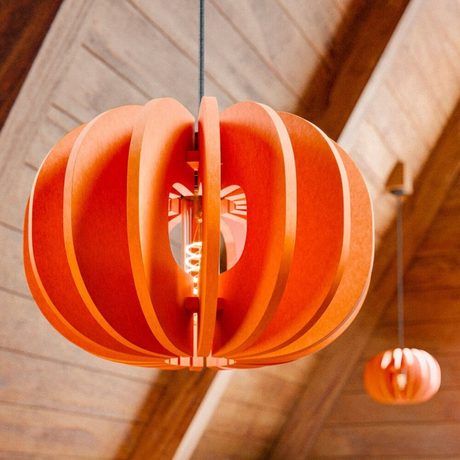
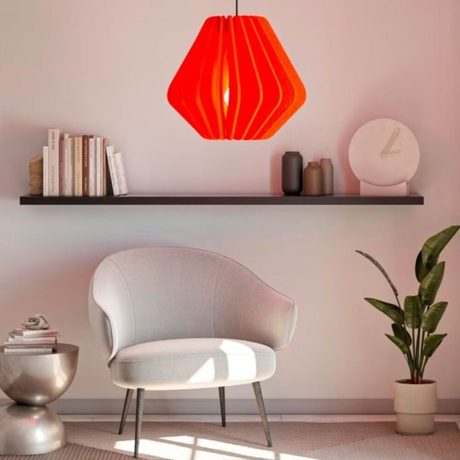
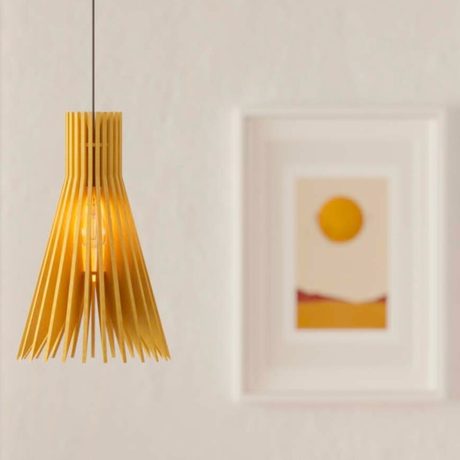
In a world where making the most of space and acoustic comfort are becoming major concerns, acoustic lights are emerging as a revolutionary two-in-one solution. These innovative fittings combine lighting efficiency with acoustic performance, meeting the growing demand for more comfortable workplaces, restaurants and reception areas.
Unlike traditional solutions, which require separate installations for lighting and acoustic treatment, these multifunctional lights make the most of the available space while reducing installation and maintenance costs.
How acoustic lights work
Acoustic lights incorporate sound-absorbing materials directly into their structure. This design allows them to reduce reverberation while delivering high-quality light. The principle relies on acoustic foams, textile fibres or porous materials specially designed to absorb sound waves in the mid and high frequencies.
Technologies and materials used
- High-performance acoustic foams: built into the light diffusers
- Technical textile fibres: for an attractive finish and optimal absorption
- Perforated panels: allowing both light diffusion and sound absorption
- Low-energy LEDs: for efficient, long-lasting lighting
Sound absorption coefficient
Acoustic performance is measured by the weighted sound absorption coefficient alpha (αw), which is generally between 0.6 and 0.9 for professional-quality acoustic lights. This value indicates the proportion of sound energy absorbed relative to the incident energy.
Applications and spaces
Open-plan offices and collaborative workspaces
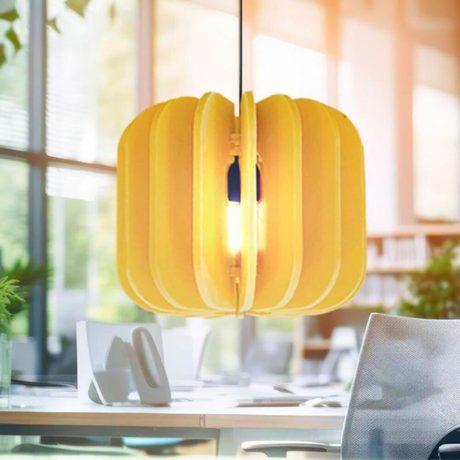
In modern workplaces, these lights significantly reduce noise from phone calls, conversations and office equipment. Installing pendant lights creates zones of acoustic comfort while maintaining uniform lighting suited to demanding visual tasks.
Combined with our hanging acoustic dividers, they help you define more private work areas without fixed partitions.
Restaurants and hospitality (Horeca) venues
The restaurant sector benefits particularly from this technology. Acoustic lights make it possible to control the sound environment without compromising the look of the venue, a crucial element of the customer experience.
Educational establishments
In schools and universities, the improved speech intelligibility these solutions provide supports concentration and learning. Equipped classrooms show an average reduction in reverberation time of 30 to 40%.
Technical and economic benefits
Making the most of space
- Fewer elements to install on the ceiling
- Simplified building services
- Centralised maintenance on a single fitting
Energy performance
The LED technology built into these lights ensures reduced electricity consumption, often 60% lower than conventional lighting solutions, while offering an extended lifespan of 50,000 hours on average.
Installation flexibility
These fittings adapt to different mounting methods: direct suspension, integration into acoustic ceiling tiles for suspended ceilings, or mounting on technical tracks, depending on architectural constraints.
Selection criteria and sizing
Assessing acoustic requirements
Choosing an acoustic light depends on several parameters:
- Room volume: directly affects the amount of absorption required
- Type of activity: quiet offices vs collaborative spaces
- Frequencies to treat: depending on the dominant noise sources
- Target reverberation time: generally between 0.6 and 0.8 seconds for offices
Lighting requirements
The required illuminance varies with use: a minimum of 300 lux for offices according to standard EN 12464-1, up to 500 lux for precision tasks. Lighting uniformity and colour temperature (generally between 3000K and 4000K) should also be considered.
Installation and maintenance
Installing acoustic lights requires technical expertise to optimise their positioning. The recommended spacing between lights ranges from 2 to 4 metres, depending on ceiling height and light output.
Preventive maintenance mainly involves regular dusting of the acoustic surfaces and checking LED performance. The modular design of these fittings makes it easy to replace faulty components without removing the whole unit.
Future developments
The future of acoustic lights lies in the integration of smart sensors that automatically adjust lighting and acoustic treatment according to occupancy and how spaces are used. Connected control technologies now offer the possibility of centralised management and real-time energy optimisation.