Advice & Expertise · Buying Guides & Comparisons
Acoustic ceiling solutions: ceiling tiles vs hanging acoustic panels compared
Published on 7 March 2026By Jonathan Rousseau4 min read

Acoustic ceiling solutions: why treating from above matters
The ceiling is a crucial surface in the acoustic treatment of commercial spaces. Unlike walls, this often-overlooked area offers considerable potential for improving acoustic comfort. Acoustic ceiling solutions effectively reduce reverberation and absorb the unwanted noise that travels through a room.
In open-plan offices, meeting rooms and dining areas, the choice of ceiling acoustic treatment has a direct impact on speech intelligibility and occupant wellbeing. Professionals have two main options: acoustic ceiling tiles fitted into a suspended ceiling and hanging acoustic panels.
Acoustic ceiling tiles for suspended ceilings: discreet integration
How they work and installation
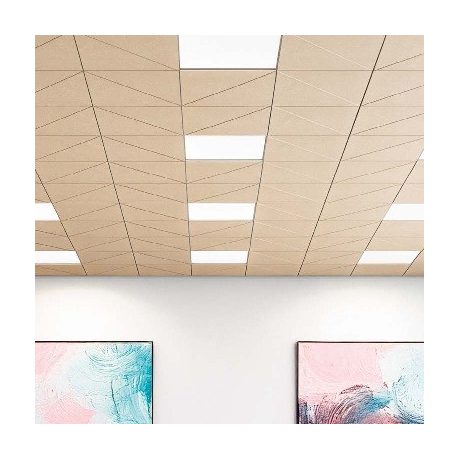
Acoustic ceiling tiles for suspended ceilings fit directly into the existing structure, replacing conventional mineral tiles. This solution offers a discreet approach to acoustic treatment, preserving the clean look of contemporary spaces.
Installation is on a standard metal ceiling grid, making maintenance and access to building services easy. The tiles come in several formats:
- 600 x 600 mm for modular spaces
- 1200 x 600 mm for large areas
- Custom formats to suit architectural constraints
Acoustic performance
Acoustic ceiling tiles have sound absorption coefficients that vary according to their composition. High-end models achieve remarkable performance:
- Sound absorption coefficient αw up to 0.95
- Reverberation reduced by up to 40%
- Speech intelligibility improved by 25 to 35%
Advantages and limitations
This solution has undeniable strengths for demanding commercial spaces. Seamless integration into the existing suspended ceiling avoids major building work while keeping the ceiling height. Ease of maintenance is also a significant operational advantage.
However, acoustic ceiling tiles do have some limitations. Their sound absorption capacity remains lower than that of thick hanging panels. Their look, while discreet, can seem monotonous in some creative environments.
Hanging acoustic panels: performance and design
Concept and installation
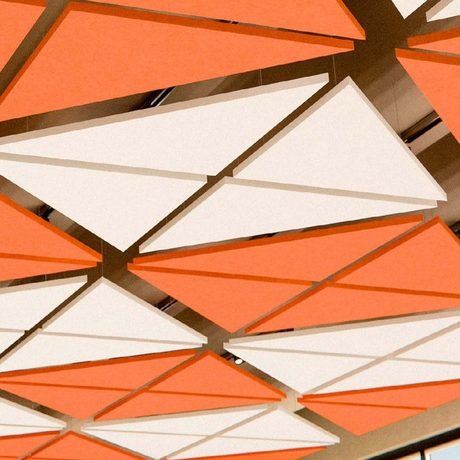
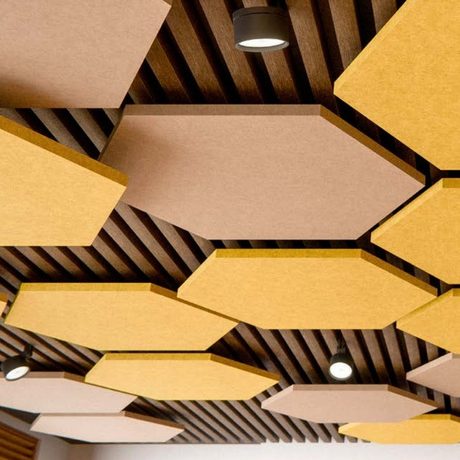
Hanging acoustic panels take a different approach, turning acoustic treatment into an architectural feature. Suspended on cables or rods, they add visual depth while delivering superior acoustic performance.
This solution allows remarkable architectural creativity. The panels come in a wide range of geometric shapes, colours and textures, so you can create unique compositions tailored to the identity of each space.
Enhanced acoustic efficiency
The greater thickness of hanging panels, generally between 40 and 80 mm, gives them exceptional sound absorption properties. Acoustic ceiling solutions of this type easily achieve αw coefficients above 1.00 thanks to the edge effect.
Suspension also creates an air gap between the panel and the ceiling, producing a resonator effect that improves low-frequency absorption. This feature is particularly valuable in spaces with high reverberation.
Flexibility and customisation
Hanging panels offer exceptional modularity. Their adjustable positioning lets you adapt the acoustic treatment as the use of the space changes. Maintenance can be carried out without removing everything, making it easier to access building services in the ceiling.
The wide range of finishes available meets the most varied aesthetic requirements:
- Technical fabrics in an extensive colour palette
- Wood finishes for a warm atmosphere
- Perforated surfaces with a contemporary design
- Custom geometric compositions
Technical and cost comparison
Acoustic performance
The comparative analysis reveals significant differences between the two acoustic ceiling solutions. Hanging panels generally lead in terms of raw performance, while ceiling tiles offer a balanced compromise.
| Criterion | Acoustic ceiling tiles | Hanging panels |
|---|---|---|
| Sound absorption coefficient | 0.70 to 0.95 | 0.85 to 1.20 |
| Reverberation reduction | 25 to 40% | 40 to 60% |
| Low-frequency efficiency | Moderate | High |
Cost considerations
The initial investment varies considerably depending on the solution chosen. Acoustic ceiling tiles generally have a lower purchase price, but hanging panels can prove more cost-effective in the long run thanks to their greater durability and ease of maintenance.
Installation also affects the overall budget. Ceiling tiles require an existing or new suspended ceiling, whereas hanging panels can be fitted to any type of supporting structure.
Selection criteria by environment
Open-plan offices and workspaces
In collaborative workspaces, hanging panels offer a decisive advantage. Their superior efficiency at absorbing overlapping conversations significantly improves user comfort. The ability to create targeted treatment zones optimises cost-effectiveness.
Commercial spaces
Restaurants, hotels and shops often prioritise aesthetics. With their variety of shapes and colours, hanging panels blend naturally into elaborate interior design concepts while solving acoustic issues.
Sensitive facilities
Schools, nurseries and healthcare facilities require high acoustic performance to ensure speech intelligibility. Acoustic ceiling tiles, with their discreet integration and ease of cleaning, meet hygiene requirements while improving acoustic comfort.
Expert recommendations
The choice between ceiling tiles and hanging panels depends on many factors. A thorough analysis of technical, aesthetic and budgetary constraints will point you towards the best solution. The expertise of a professional acoustician ensures the chosen solution matches the expected performance.
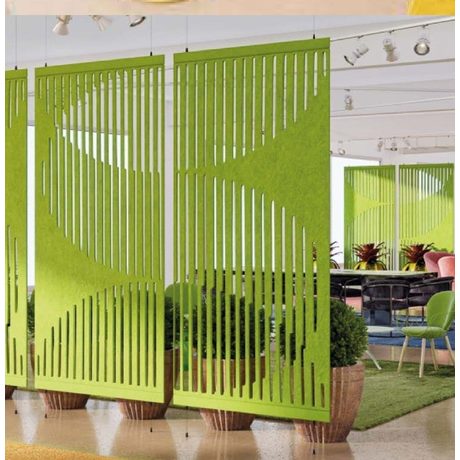
To maximise the effectiveness of acoustic ceiling solutions, combining them with other treatment elements (wall panels, dividers) can be a smart move. This holistic approach optimises acoustic comfort while respecting the architectural constraints of each project.