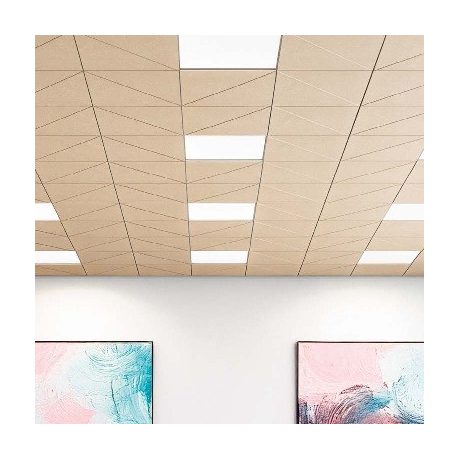
Noisy School? Acoustic Ceiling Tiles for Suspended Ceilings to Improve Learning
Published on 7 March 2026By Jonathan Rousseau4 min read

The acoustic challenge facing modern schools
Schools today face a major challenge: noise pollution, which significantly undermines the quality of learning. Pupils' voices, scraping chairs, technology equipment and sound reverberating off hard surfaces quickly turn classrooms into noisy environments that make concentration difficult.
The consequences of this noise pollution are many: listening fatigue for teachers, concentration difficulties for pupils, lower academic performance and increased stress for everyone in the building. To address these issues, acoustic ceiling tiles for schools offer an effective and attractive way to transform the learning environment.
Why choose acoustic ceiling tiles for suspended ceilings in schools?
Acoustic tiles designed specifically for schools offer many advantages over traditional ceilings. Unlike smooth surfaces, which reflect sound and create reverberation, these acoustic ceiling tiles for schools effectively absorb sound waves.
Optimised acoustic performance
Modern acoustic tiles achieve high sound absorption coefficients, particularly in the frequency range of the human voice (250-4000 Hz). This targeted absorption makes it possible to:
- Reduce the reverberation time in classrooms
- Improve speech intelligibility
- Lower ambient noise levels
- Create a calmer environment that supports learning
Easy installation and maintenance
Installing acoustic tiles in a suspended ceiling offers considerable practical benefits for schools. The suspended ceiling system provides easy access to building services (lighting, ventilation, cabling) while delivering a high-performing acoustic surface.
Acoustic solutions for different school spaces
Every space in a school presents its own acoustic challenges that call for tailored solutions. Acoustic ceiling tiles for suspended ceilings can be adapted to the needs of each environment.
Traditional classrooms
In standard classrooms, the main objective is to optimise the intelligibility of the teacher's voice while reducing unwanted noise. Acoustic tiles help create an environment where every pupil can clearly hear instructions and take an active part in discussions.
Multi-purpose halls and gyms
These high-ceilinged spaces require more extensive acoustic treatment. High-performance acoustic tiles help control the excessive reverberation that is often typical of such large volumes.
Libraries and study areas
In these areas dedicated to individual work and concentration, acoustic ceiling tiles for schools create a hushed atmosphere that is conducive to studying and reading.
Selection criteria for acoustic tiles in schools
Essential technical performance
The choice of acoustic tiles should be based on precise technical criteria:
- Absorption coefficient αw: favour tiles with an αw ≥ 0.85
- Fire rating: comply with fire safety standards (Euroclass A1 or A2)
- Mechanical strength: choose tiles that are resistant to impact and wear
- Ease of maintenance: opt for washable or vacuumable surfaces
Aesthetic and educational considerations
The visual appearance of acoustic tiles also helps to create a stimulating learning environment. Customisation options make it possible to incorporate decorative or educational elements while retaining acoustic performance.
Installation and maintenance: best practice
The effectiveness of acoustic tiles depends largely on the quality of their installation. To maximise performance, it is advisable to use experienced professionals who understand the specific requirements of school environments.
Preparation and installation
Installation requires careful preparation of the existing substrate and compliance with the installation rules specific to each type of tile. The airtightness of the system and the continuity of the acoustic treatment are crucial to achieving the expected performance.
Regular maintenance
Appropriate maintenance extends the service life of acoustic tiles and maintains their performance over time. Cleaning protocols must be compatible with the materials used and meet the hygiene requirements of school environments.
Combining with other acoustic solutions
To optimise the overall acoustics of a school, ceiling tiles can be supplemented with other elements. Hanging acoustic panels, for example, offer a complementary solution for treating specific areas or creating defined work spaces.
Impact on the quality of teaching
Improving acoustics with acoustic ceiling tiles for schools delivers measurable benefits for the quality of teaching. Studies show that pupils working in an acoustically optimised environment achieve better academic results, sustain their attention for longer and feel less tired at the end of the day.
Teachers also benefit from these improvements: less vocal strain, better transfer of knowledge and a calmer classroom atmosphere. These optimal conditions help create a virtuous circle in which learning and wellbeing reinforce each other.