Acoustic wall panels vs hanging panels: which to choose for your open-plan office?
Published on 7 March 2026By Jonathan Rousseau4 min read
The acoustic challenges of the modern open-plan office
The open-plan office has become a fixture of corporate architecture, but it poses major acoustic challenges that directly affect employee productivity and wellbeing. With excessive reverberation, a lack of speech privacy and difficulty concentrating, acoustic solutions have become a necessity. Two approaches stand out: hanging acoustic panels and traditional wall-mounted panels.
Your choice between these solutions determines not only how effective the acoustic treatment is, but also the look and functionality of your workspace. Each option has its own advantages depending on the layout of your open-plan office, your budget and your acoustic objectives.
Acoustic wall panels: the classic, proven solution
How they work and how they are installed
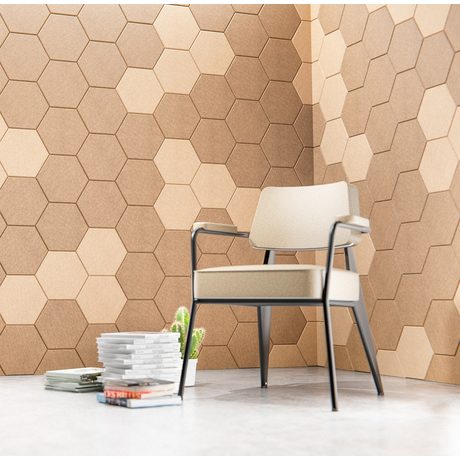
Acoustic wall panels are fixed directly to the vertical surfaces of your open-plan office. This traditional solution offers a direct approach to acoustic treatment by targeting the main reflective surfaces. Installation is usually by screwing or gluing, depending on the substrate and the weight of the panels.
Advantages of wall panels
- Simple installation: fixed directly, with no complex support structure
- Controlled cost: generally a less expensive solution than hanging systems
- Space-saving: does not encroach on the usable volume of the room
- Easy maintenance: direct access for cleaning and upkeep
- Design flexibility: a wide choice of finishes and patterns available
Our range of acoustic wall panels offers solutions suited to every professional environment, combining acoustic performance with contemporary design.
Limitations of wall panels
Despite their advantages, wall panels have certain limitations in open-plan offices. Their effectiveness is confined to areas close to the walls, sometimes leaving the centre of the space less well treated acoustically. In addition, they do not always make it possible to create zones of speech privacy in the heart of the open-plan office.
Hanging acoustic panels: innovation in the service of effectiveness
Technology and positioning
Hanging acoustic panels represent an innovative approach to acoustic treatment. Suspended from the ceiling by cables or rods, they can be positioned strategically throughout the workspace. This flexibility of placement allows more even and targeted acoustic treatment.
Advantages of hanging panels
- Optimum acoustic effectiveness: treatment possible in every area of the open-plan office
- Flexible positioning: adapted to circulation routes and work areas
- Creation of micro-environments: acoustic zoning of spaces without physical partitions
- Architectural design: a decorative element that structures the space
- Enhanced performance: sound absorption on both sides of the panel
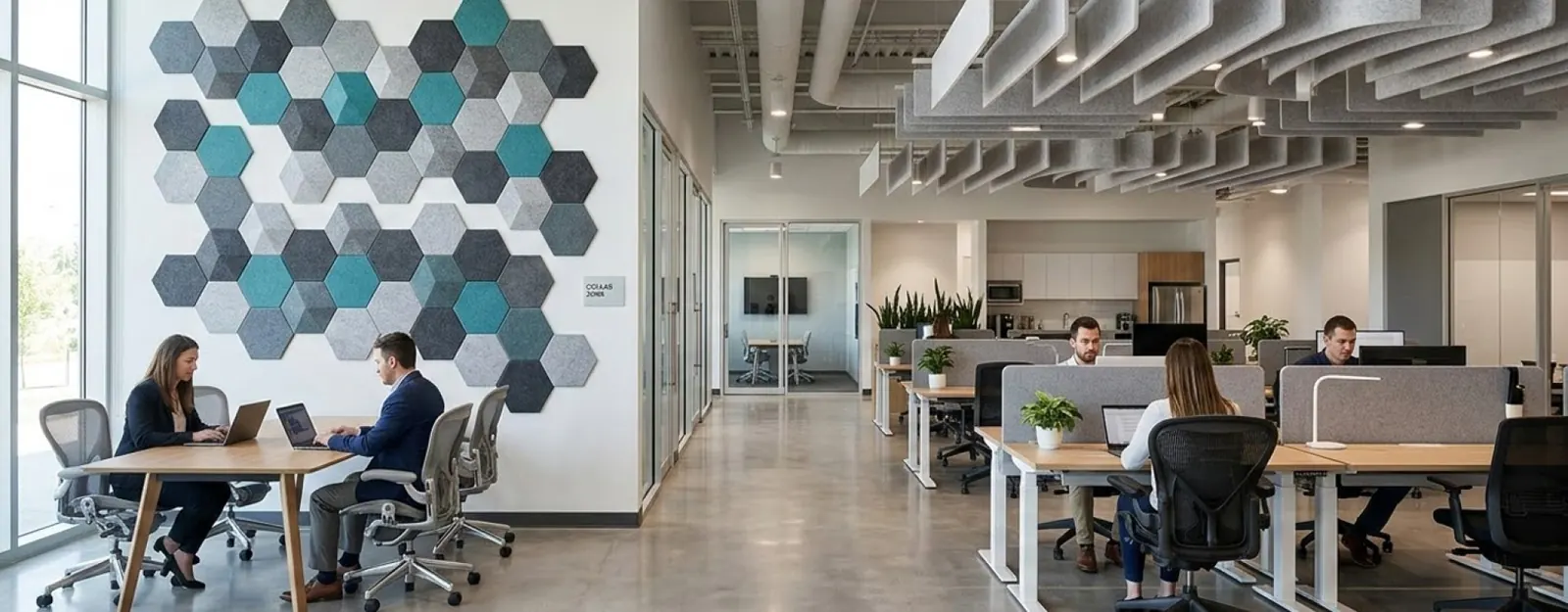
Hanging acoustic dividers offer a solution particularly well suited to large spaces, allowing the space to be structured both acoustically and visually.
Technical considerations
Installing hanging panels requires a prior assessment of the ceiling structure to ensure its load-bearing capacity. The suspension system must be sized according to the weight of the panels and any seismic requirements. The suspension height directly influences acoustic effectiveness and must be calculated according to the specific features of your space.
Comparative analysis: the key selection criteria
Acoustic performance
In terms of pure performance, hanging acoustic panels generally have the edge thanks to their strategic positioning and their two active faces. They allow a more even reduction in reverberation time across the whole open-plan office. Wall panels remain effective, but with a more limited area of influence.
Flexibility and scalability
Hanging panels offer greater flexibility to adapt as your organisation evolves. They can be repositioned without major works, unlike wall panels, which need to be refixed if changed. This adaptability is a major asset in a constantly changing professional environment.
Aesthetic and architectural impact
Each solution makes its own aesthetic contribution. Wall panels blend discreetly into the existing architecture, while hanging panels become design features in their own right, visually structuring the space and creating dynamic perspectives.
Recommendations for your layout
For medium-sized open-plan offices (100-300 m²)
In this type of layout, a combined solution often proves optimal: wall panels around the perimeter to deal with reflections off the walls, complemented by a few hanging panels strategically positioned at points where sound converges.
For large open-plan offices (>300 m²)
Large spaces benefit more from an approach based on hanging acoustic panels, which allows effective acoustic coverage across the entire floor area. This solution offers the flexibility needed to create distinct acoustic zones according to activity.
For spaces with limited height
Where the ceiling height is limited (less than 2.8 m), wall panels remain the go-to solution. They preserve the sense of space while providing the necessary acoustic treatment.
Conclusion: a strategic decision for your working environment
Choosing between acoustic wall panels and hanging panels is not merely a technical question. It is a strategic decision that has a lasting impact on the acoustic quality, aesthetics and functionality of your open-plan office. Wall panels are ideal for standard spaces with conventional acoustic needs and a controlled budget. Hanging acoustic panels are the clear choice for demanding environments that require optimum acoustic performance and flexible layouts.
Wisecom Acoustic's expertise supports you in this decision by offering a personalised acoustic study, ensuring you choose the solution best suited to your specific requirements. Our complete range of designer acoustic products meets every challenge of the modern open-plan office, combining technical performance with contemporary aesthetics.